
Description
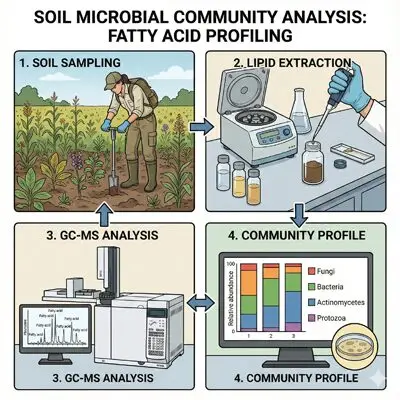
We detect and quantify phospholipid fatty acids (PLFA) for the ecological profiling of soil samples. Because phospholipids degrade rapidly on cell death, PLFA profiles reflect the living microbial community at the moment of sampling. Total PLFA therefore serves as a quantitative index of viable microbial biomass, while the individual biomarkers resolve which community groups are present and in what proportion.
We conduct:
- Soil PLFA extraction and derivatization
- GC-MS/FID analysis
- Reporting of soil microbial community profiles (Soil Microbial Ecology Report). Click here to see an example of one of our “Soil Microbial Ecology” reports.
Which option should you order?
| Option | Choose this if |
|---|---|
| Extraction + GC-MS analysis + soil profile reporting | You are sending soil. This is the complete service and the correct choice for most clients. |
| GC-MS analysis + soil profile reporting | You have already extracted and derivatized your samples and are sending fatty acid methyl esters in solvent, and you want the full ecological report. Solvent and volume: hexane (at least 1 mL) State required: FAME FAME should be provided at concentrations in the micromolar to nanomolar range |
What you receive
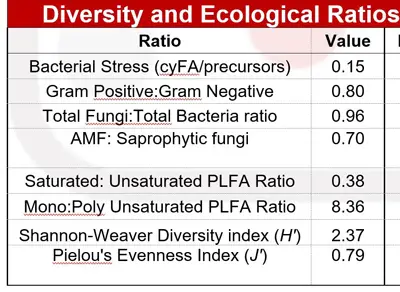
Absolute concentrations for each identified PLFA, reported in nmol g⁻¹ dry soil, together with total PLFA as a living-biomass index, the community group sums, and the calculated ratios and diversity indices listed below. Data are delivered as a formatted report with the underlying quantification table.
Turnaround: approximately 2-3 weeks from receipt of samples. For larger sample sets (>50 samples), the turnaround could be longer; please contact us to check whether a rush option exists.
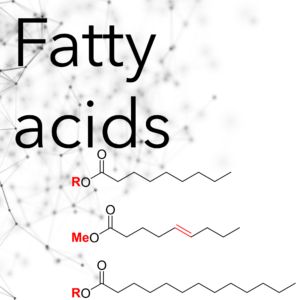
Fatty acids detected and quantified
- Unsaturated (mono and poly) fatty acids
- Branched fatty acids (iso, anteiso, and mid-chain)
- Cyclic fatty acids
- Saturated fatty acids (C2–C36)
Microbial community groups
We resolve and report the following groups:
- Bacteria, distributed across subgroups
- Gram-positive
- Gram-negative
- Actinomycetes
- Nitrite-oxidizing bacteria (NOB)
- Fungi
- Saprophytic fungi
- Arbuscular mycorrhizal fungi (AMF)
Every biomarker we report is identified against an authenticated commercial standard, verified by both retention time and mass spectrum, and quantified using a determined response factor. Our library is expanded regularly.
- Bacteria: 15 PLFA biomarkers, distributed across bacterial subgroups
- Gram-positive: 7 PLFA biomarkers.
- Gram-negative: 4 PLFA biomarkers.
- Actinomycetes: 3 PLFA biomarkers.
- Nitrite-Oxidizing bacteria (NOB): 1 PLFA biomarker.
- Fungi: 3 biomarkers
- Saprophytic Fungi: 2 biomarkers
- Arbuscular Mycorrhizal Fungi (AMF): 1 biomarker
Diversity indices, ecological ratios and physiological indicators
- Bacterial stress indicator (cyclopropane fatty acids to their monounsaturated precursors)
- Gram-positive to Gram-negative ratio
- Fungi to bacteria ratio
- Arbuscular to saprophytic fungi ratio
- Saturated to unsaturated PLFA ratio
- Mono- to polyunsaturated PLFA ratio
- Shannon-Weaver diversity index (H’)
- Pielou’s evenness index (J’)
Isomer declaration. Cyclopropane fatty acids occur as isomers that are chromatographically and biologically distinct and are not interchangeable in stress-ratio calculations — cy19:0ω7 (lactobacillic acid, cis-11,12) is formed from 18:1ω7, whereas cy19:0ω9 (dihydrosterculic acid, cis-9,10) is formed from 18:1ω9. Many laboratories do not distinguish them. We state in every report which isomer standard underlies the reported ratio, and which precursor it is paired against, so that the calculation can be cited accurately in your methods section.
Before shipping: soil declaration and authorization
Soil entering our laboratory is regulated by the Canadian Food Inspection Agency (CFIA, Directive D-95-26). After placing your order, please complete the soil sample declaration form using your order number. We review it and reply within 2 business days.
Do not ship any samples until you receive our written authorization. Samples from outside Canada travel under our CFIA import permit, a copy of which we send with the authorization. Soil from a CFIA-regulated area of Canada, or soil previously imported by someone else, requires a CFIA Movement Certificate obtained by the shipper. Samples are never returned: they are destroyed 3 months after the report is delivered.
FAME extracts in hexane (GC-MS analysis option) are not soil and do not require the declaration form.
Sample requirements
| Quantity | 5–10 g dry-weight equivalent per sample (maximum 10 g). For soils low in organic matter or heavily amended with mineral material, contact us before ordering. |
| Condition | Frozen or freeze-dried only. Sieve to 2 mm before freezing where possible. Frozen storage is the recommended condition for PLFA and presents no difficulty, provided samples have not undergone repeated freeze–thaw cycles. Fresh, refrigerated or air-dried soil is not accepted. |
| Containers | Glass vials with PTFE-lined screw caps, or aluminium foil packets, each labelled with your order number and sample ID, then placed together in a sealed plastic bag inside a rigid outer box. Avoid soft plastics and Parafilm in contact with the soil, which introduce lipid contamination. |
| Shipping | Frozen samples: on dry ice, in quantity sufficient for the full transit time; samples must not thaw in transit. Freeze-dried samples may be shipped at ambient temperature. Ship Monday to Wednesday by tracked courier, and email us the tracking number on the day of shipment so that someone is present to receive it. Full packaging and customs instructions are sent with the shipping authorization. |
Scope of this analysis
PLFA measures the living microbial community and its composition. It does not replace, and we do not offer alongside it, the following:
- Microbial biomass carbon and nitrogen by chloroform fumigation–extraction. This requires instrumentation we do not hold. Where your objective is to quantify how microbial biomass responded to a treatment, total PLFA answers that question directly and additionally resolves which community groups drove the response; biomass C and N are necessary mainly where biomass is required in mass-of-element units for a nutrient budget. Total PLFA and biomass C are strongly correlated in temperate soils, with published conversion factors of the order of 4 µg biomass C per nmol total PLFA, so an approximate cross-reference to published MBC values is possible where needed. Note also that fumigation–extraction requires field-moist soil held at 4 °C, since freeze–thaw lyses part of the biomass and biases the result — frozen archive samples suitable for PLFA are generally not suitable for that method.
- DNA- or RNA-based community profiling (amplicon sequencing, qPCR).
- Soil respiration, enzyme activity assays, or nutrient analyses.
For larger sample sets, or to discuss whether PLFA suits your study design, contact us at ahmad.saleh@bcm.ulaval.ca before ordering.